The publication of Decree No. 12.153/2024, signed this Monday (08.26.2024), aims primarily at increasing the supply of natural gas and reducing the price for the end consumer.
Key points of the Decree are as follows:
- Creation of the National Integrated Plan for Natural Gas and Biomethane Infrastructures (“PNIIGB”);
- Subsidiary application of the regulated third-party access regime to transmission infrastructure for the gathering and processing of natural gas;
- The possibility of revising development plans with the objective of reducing the levels of natural gas reinjection;
- Authority to the ANP to promote actions to ensure transparency in price formation and identify the costs of natural gas, its derivatives, and biomethane, practiced by market agents;
- Temporary adoption of the postal rate model for transportation tariffs, with the adoption of a uniform tariff charged to all shippers in the transportation system;
- The possibility for the ANP to execute conduct adjustment (settlement) agreements; and
- The creation of the Natural Gas Sector Monitoring Committee.
Firstly, Decree No. 12,153/2024 establishes as a guideline for the application of Law No. 14,134/2021 (“Gas Law”), in addition to the objectives of the National Energy Policy, the harmonization of federal and state regulations related to the gas industry.
- PNIIGBThe Decree creates the PNIIGB with the objective of monitoring and planning the supply, demand, and infrastructure of natural gas and biomethane in Brazil. The plan is to be prepared by the Energy Research Office (EPE), with input from ANP – including the consolidation of information submitted in coordinated plans prepared by the market area capacity manager – and ANEEL – regarding the projection of natural gas thermoelectric consumption. EPE may also request information from local distribution companies on network expansion plans, as well as conduct public calls (market tests) to estimate demand for infrastructure services and the potential supply and demand for natural gas and its derivatives. For this last point, EPE may request support from ANP and transporters to conduct the public call. EPE must hold a public consultation on the PNIIGB and submit it for approval by the MME.
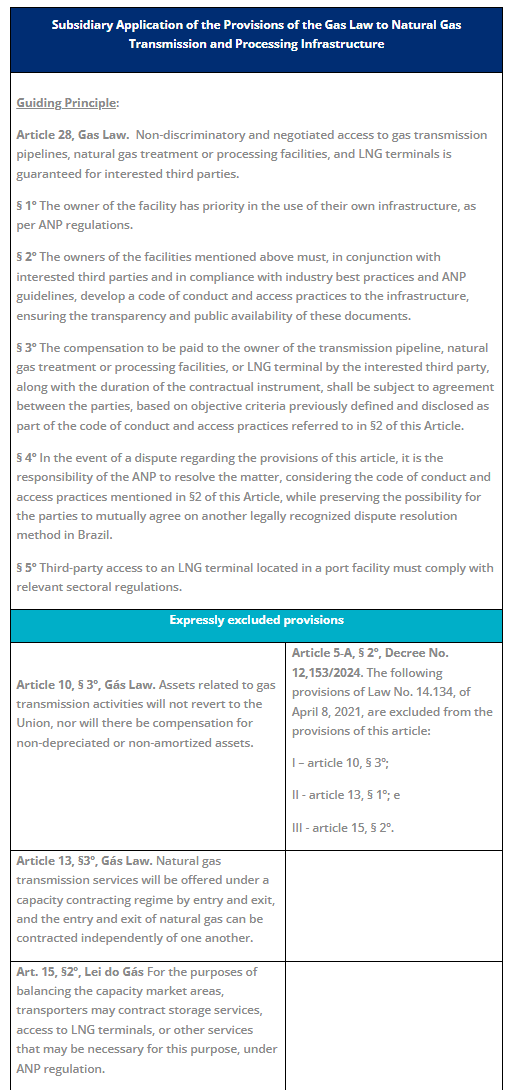
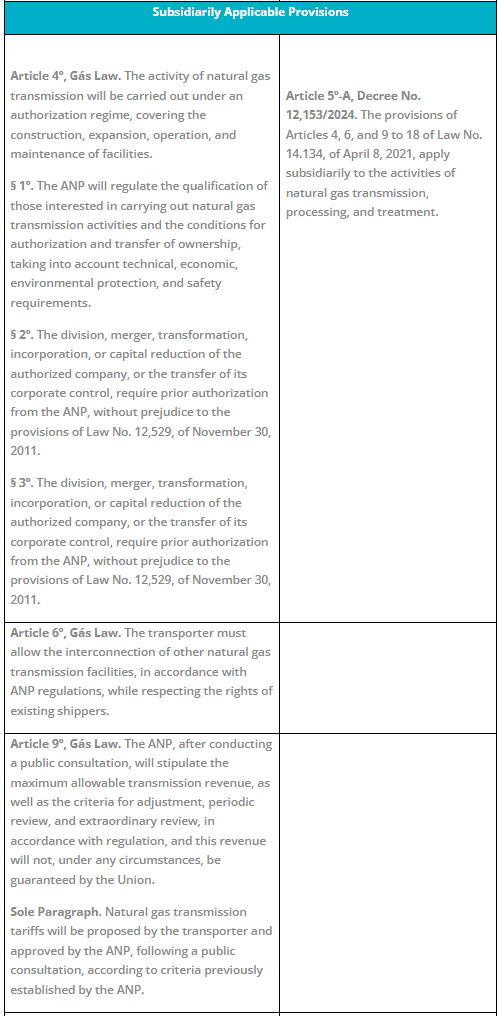
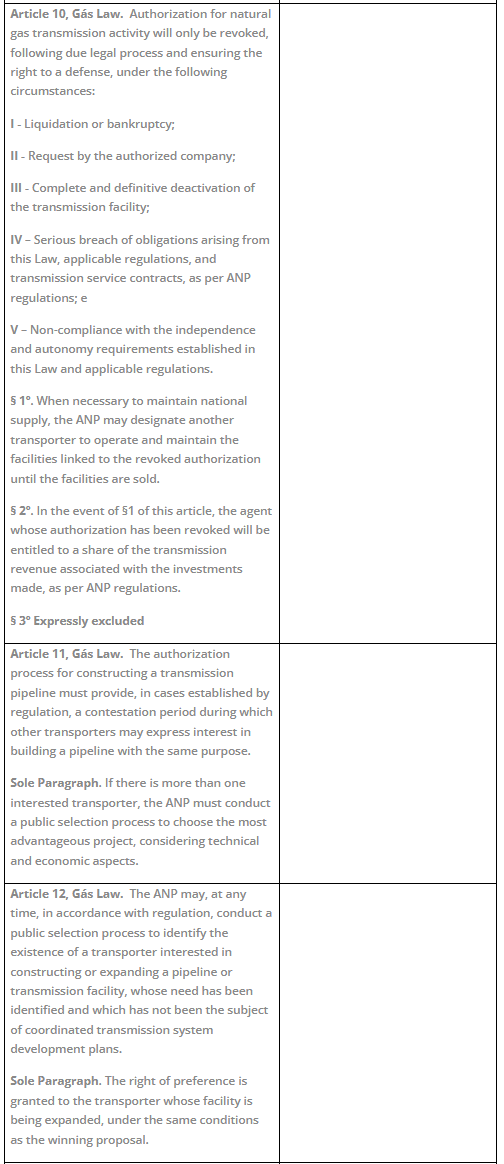
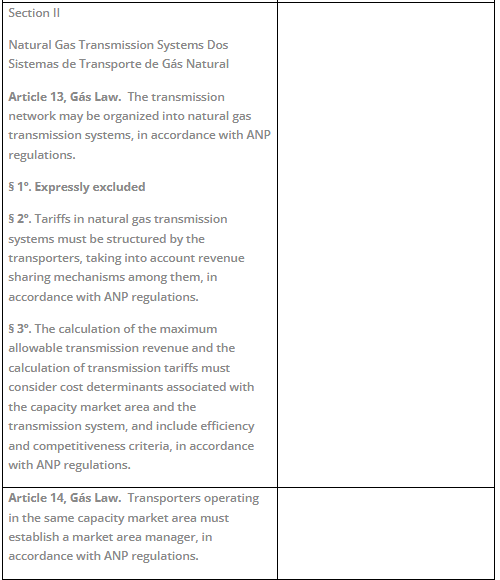
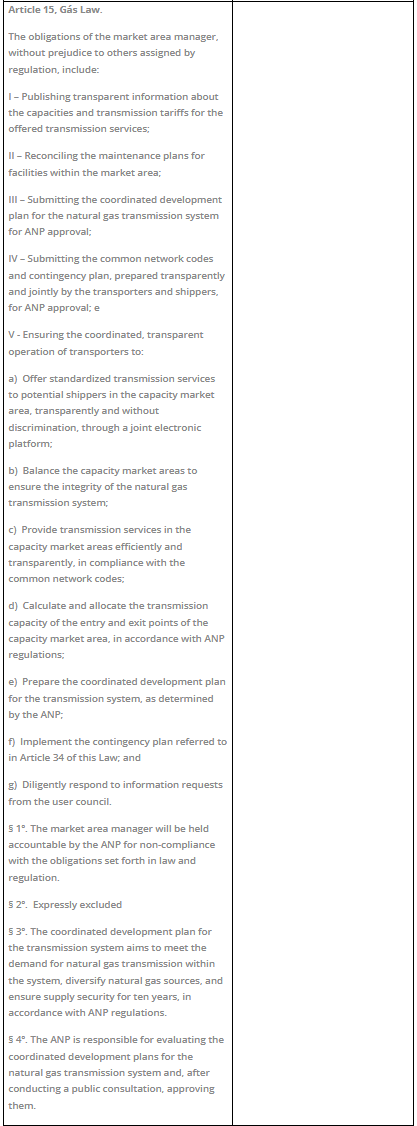
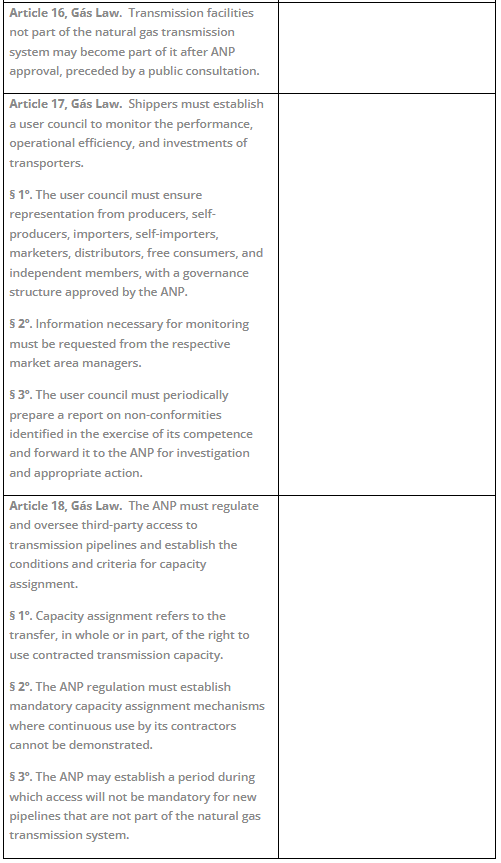
- Regulated third-party access regimeIt also provides for the subsidiary application of provisions of the Gas Law (Articles 4, 6, and 9 to 18) related to pipeline transmission of gas to gathering pipelines and processing infrastructures. The content of the provisions for subsidiary application is consolidated in Table 1 at the end of this Client Alert. In summary, they refer to (i) the organization as a system and the possibility of non-integrated installations becoming part of the System (Articles 13 and 16 of the Gas Law); (ii) the creation and responsibilities of the market area manager (Articles 14 and 15 of the Gas Law); (iii) the creation of the users’ council (Article 17 of the Gas Law); (iv) the criteria for granting and revoking authorizations (Articles 4 and 10 of the Gas Law); (v) the application of a dispute period for new authorizations and the potential for holding a public selection process (Articles 11 and 12 of the Gas Law); (vi) the calculation of the Maximum Allowed Revenue (Article 9 of the Gas Law) and guidelines for tariff calculation (Article 13 of the Gas Law); (vii) the interconnection of other installations (Article 6 of the Gas Law); (viii) the regulation and supervision of capacity transfer by ANP (Article 18 of the Gas Law).
The following provisions have been expressly excluded: (i) non-reversal of amortized assets (Article 10, §3 of the Gas Law); (ii) capacity offering by entry and exit (Article 13, §1); and (iii) the possibility of contracting flexibility services from LNG Terminals and storage units for system balancing purposes. However, it is not clear what the extent of the subsidiary application of these provisions will be, especially considering Article 28 of the Gas Law, which allows for the negotiated access regime to such infrastructures.
- Possibility of Revising Development Plans
Another key point brought by the Decree is the provision that ANP may determine the revision of current development plans for oil and natural gas production fields, to consider access to production gathering pipelines and treatment and processing facilities. - ANP’s Authority to Promote Actions to Ensure Price Transparency and Identify Costs
- Temporary Adoption of the Postal Rate Model for Transmission TariffsAmong other competencies assigned to ANP, the Decree creates the authority to “promote actions to ensure transparency in price formation and identify the costs of natural gas, its derivatives, and biomethane, practiced by market agents.” Given that the commercialization of gas and biomethane are considered free enterprise activities, the extent of application of this provision may be legally questioned and has already been subject to disputes in other sectors.
The Decree also mandates that infrastructure operators—transmission, gathering, and processing—must submit to ANP a proposal for the calculation of their Regulatory Asset Base (“RAB”) within 180 days from the date of publication, by 02.23.2025. The Decree allows ANP to adopt a temporary value for the RAB until a definitive RAB is determined by the Agency. Meanwhile, “until regulatory actions related to transmission tariffs are completed,” tariffs should preferably adopt the postal rate system, defined in the decree as “the uniform tariff charged to all shippers in the natural gas transmission system, regardless of distance, location in the pipeline network, and operator, which may differ between entry and exit points.”
- Possibility for ANP to Execute Conduct Adjustment Agreements
The Decree provides that ANP may enter into conduct adjustment agreements with sector agents when it identifies behaviors that (i) undermine market openness and liquidity or (ii) may harm consumer supply or the objectives set out by Law No. 9,478/1997 (“Petroleum Law”) and the Gas Law. Additionally, the regulatory framework grants ANP the authority to re-adjust any instrument executed when a “discrepancy with legal or regulatory norms and with international best practices of the oil and natural gas industry” is identified. - Creation of the Natural Gas Sector Monitoring CommitteeFinally, the Decree establishes the MME shall create the Natural Gas Sector Monitoring Committee “with the purpose of providing advice, coordination, monitoring of public policies, proposal formulation, and decision-making for the natural gas sector.” When establishing this committee, the Ministry will define its composition, which will involve permanent members and invitees, as well as set out its competencies and operational framework.
We understand that the provisions introduced by the Decree are not of immediate implementation, still depending on definitions by ANP and possibly other authorities. Some of these provisions may also be subject to legal and applicability discussions.
Our team is available to assess how these changes may impact operations and to offer support on related issues.
Table 1: