Both the ENSIC and the National Plan are, together with the Integrated Data System of Critical Infrastructure Security, instruments of the National Policy of Critical Infrastructure Security (“PNSIC“), which had been established by Decree No. 9,573, of November 22, 2018.
Critical infrastructure is the structures, services, goods and systems of which interruption or destruction, total or partial, may cause “serious social, environmental, economic, political, international impact or to the security of the State and society”. Such infrastructure plays an essential role both for national security and sovereignty, as well as for the integration and sustainable economic development of the country, especially with regard to energy, transport, water, finance and communications.
PNSIC establishes the essential guidelines for the joint effort to be developed by the authorities and entities of the public and private sectors with respect to the activity of critical infrastructure security. Law No. 13,844, of June 18, 2019, gives to the Cabinet of Institutional Security of the Presidency of Republic (Gabinete de Segurança Institucional da Presidência da República) (GSI) the competence to “monitor matters related to critical infrastructure, with priority to those related to risk assessment”.
ENSIC identifies four major focal points which are the main pillars for the effectiveness of the activity of critical infrastructure security, and defines the strategic initiatives considered essential for the implementation of the PNSIC, with emphasis on the following:
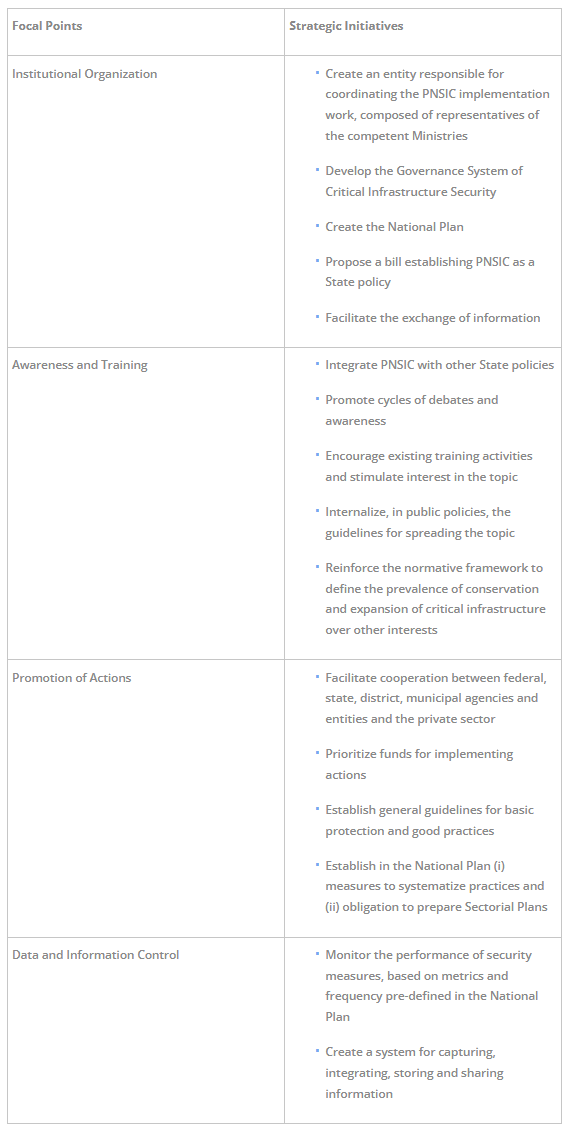
Such initiatives should guide the practical phase of implementation of the PNSIC. Thus, in order to comply with the strategic objectives established by ENSIC, several entities involved with the critical infrastructure security must develop actions which will be consolidated in the National Plan.
Our team shall continue to follow up on these developments and remain at disposal for any additional queries with respect to the PNSIC.