After a fast-track effort that allowed the legislative process to be concluded in less than five weeks, Brazil’s Federal Senate passed on Wednesday, September 4, 2024, Bill of Law No. 3,027/2024, which introduces the Low-Carbon Hydrogen Development Program (“PHBC“). Previously approved by the Chamber of Deputies, the matter will be submitted to presidential sanction.
Once enacted, the new law will complement the existing legal framework for low-carbon hydrogen (“LCH2“), which was established by Law No. 14,948/2024 and has been in force since August 2, 2024. This will enable Brazil’s National Policy on LCH2 to apply with all the mechanisms that were originally envisioned.
The President of the Republic is expected to sign the bill without vetoes, as the newly approved text addresses the concerns previously raised by the Brazilian government, which had led to the veto of Articles 30 to 35 of the bill that resulted in Law No. 14,948/2024 (Bill of Law No. 2,308/2023). These provisions related to the PHBC and were omitted from the final version of the law. We commented on this issue in our previous client alert.
What is new
In comparison to the previous version, the main innovations of the PHBC in the text that the Brazilian Congress has approved are the following:
- Expansion of the PHBC objectives: In addition to the original goals of “developing LCH2 and renewable hydrogen” and “supporting energy transition efforts”, the list of objectives of the PHBC will contemplate “setting clear targets for developing the domestic LCH2 market”, “providing incentives for decarbonization through LCH2 in hard-to-decarbonize industries such as fertilizers, steel, cement, chemicals, and petrochemicals”, and “promoting the use of LCH2 in heavy transport”.
- Specification of the PHBC mechanism: In the previous version, the PHBC was structured as a sort of fund, of “accounting and financial nature”, to be funded from various sources or resources and subject to an investment policy. Those resources were intended to support tax credits for the commercialization of LCH2 and derivatives, for a term of five years from January 1, 2028, as well as economic subsidies, for a term of ten years from the publication of the law, in both cases subject to competitive proceedings. Now, the PHBC will operate exclusively as a mechanism of tax credits, specifically concerning the Social Contribution on Net Profits (“CSLL“). The tax credit will correspond to up to 100% of the difference between the estimated price of the LCH2 and the estimated price of substitute goods, in accordance with regulation to be enacted. The percentage of the tax credit may be set as inversely proportional to the intensity of emissions of greenhouse gases (“GHG“) resulting from the hydrogen production.
- Eligibility requirements for projects: To qualify for PHBC tax credits, projects must meet at least one of the following requirements: (i) contribute to regional development; (ii) support climate change mitigation and adaptation measures; (iii) promote technological innovation and diffusion; or (iv) contribute to diversifying Brazil’s industrial base.
- Sanctions for non-implementation of projects: Companies or consortia of companies that fail to implement a project, or that implement it in a way that violates the law or regulations, will be subject to the following sanctions: (i) a fine of up to 20% of the tax credit amount designated for the project, as regulated; and (ii) collection of the amount equivalent to improperly claimed or offset tax credits or reimbursement of the credits resulted from the benefit until the last business day of the month following the date of non-compliance of the project.
What remains unchanged
Among other provisions, the new text maintains unchanged the following points of the previous version of the PHBC:
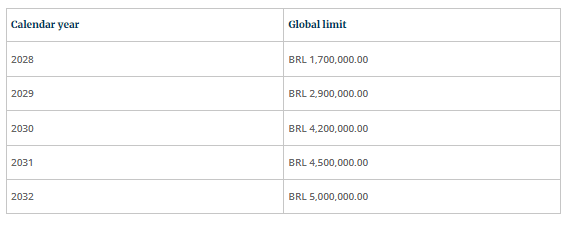
- Term of effectiveness: The PHBC will remain in effect for five years, from January 1, 2028, to December 31, 2032.
- Competitive proceeding: Access to tax credits contemplated in the PHBC will be conditioned to a competitive proceeding, to be further detailed by regulation. The list of hypotheses that the rules of the competitive proceeding may consider remains in the new text with no major changes, including the possibility of prioritizing projects that: a) contemplates the lower intensity of GHG emissions for the hydrogen produced or consumed; and (b) have the greatest potential to “densify Brazil’s national value chain”. The new text clarifies that eligible producers include not only companies or consortia that have qualified as beneficiaries of the Special Incentive Regime for LCH2 Production (Rehidro), but also those that “have previously benefited.” This inclusion is intended to prevent the PHBC from being unapplicable after January 1, 2030, as the Rehidro eligibility period lasts for five years starting on January 1, 2025 (Article 27 of Law No. 14,948/2024).
- Amount of tax credits: The Brazilian government will determine the amount of tax credits to be awarded, taking into account fiscal goals and PHBC objectives, and limited to the following global limits for each calendar year of its term of effectiveness:
Final Remarks
Meanwhile, the Steering Committee of the National Hydrogen Program (“Coges-PNH2“), led by Brazil’s Ministry of Mines and Energy (“MME“), continues to work on drafting the decree that, once signed by the President of the Republic, will establish the general regulation of the matters set forth in Law No. 14,948/2024. It is expected that this decree will also cover the regulation of the PHBC law, assuming the latter is sanctioned and comes into effect swiftly. In a second step, detailing of the regulations will be issued by Brazil’s National Petroleum, Natural Gas, and Biofuels Agency (“ANP“) and other relevant authorities, depending on the subject matter.
We continue to monitor the legal and regulatory developments in this emerging market as part of Brazil’s energy transition efforts. Our team is available to clarify any questions and discuss related issues.