On October 18th 2022, the Brazilian Data Protection Authority (“ANPD”) released the “Guidelines on Cookies and Personal Data Protection” (the “Guideline”). The Guideline provides an overview on the use of cookies, in addition to providing guidance to processing agents and the best practices on the matter, especially regarding the obtention of consent and transparency to data subjects.
In this material, the ANPD essentially addresses the following topics:
- Definition and categories of cookies.
- Guiding principles and legal basis applicable to the processing of personal data using cookies.
- Recommendations on instruments to ensure compliance with the Brazilian General Data Protection Law (“LGPD”), including banners and cookie policies.
The Guideline defines cookies as files installed on a user’s device that enable the collection of certain information, which may include personal data, for various purposes. Most of the information collected by cookies are essential to the proper functioning of electronic pages and to enable the offer of services in the digital environment as, for example, the viability of electronic payments. However, they are also used to identify and remember user login information or products added to the cart, and to serve customized advertisements.
Even though cookies are a widely used tool in the digital environment, there is much discussion about the lack of transparency regarding the method of collection and processing of user data through cookies. This transparency is a guiding principle of the LGPD, and as such, should be observed by the processing agents when offering services in the digital environment.
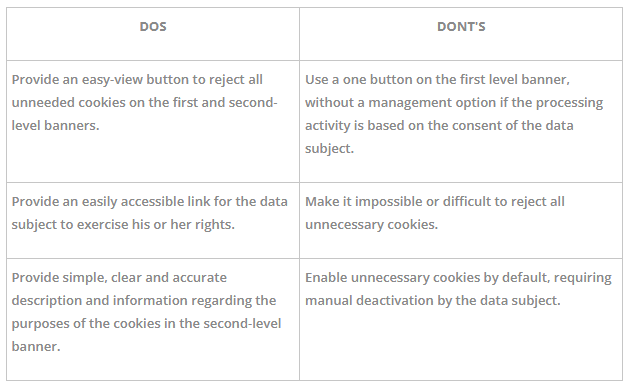
By means of the Guidelines, the ANPD sought to offer directives and confer positive and negative practices to ensure transparency to data subjects through cookie banners, of which we highlight the following:
Please note that simply following the guidelines provided by the ANPD on how to use cookies in a more transparent way is not enough to ensure the legality of the use of these technologies. Processing agents must also comply with the principles, legal bases and other provisions of the LGPD.
For further information, please contact our Privacy and Data Protection team or access the “Guidelines on Cookies and Personal Data Protection“, which will be open to comments and contributions sent to the ANPD on the Fala.BR platform.